Become a Fan

A growing number of people who love children's stories, nature writing and Americana are turning to Holling as a timeless teacher of geography, culture, history, and adventure. Become a fan and continue sharing the excitement!


Monday, May 21, 2012

Tree in the Trail, the Newest Septuagenarian


Tree in the Trail will be 70 years old this year — not a long time in some trees’ lives, but an eternity for many books. Still, readership of this evergreen classic (no pun) continues to grow. Parents are still buying the book for their children, as are grandparents who want to share a country whose values are changing too quickly.

Holling tells the story of a young Native-American boy in New Mexico who nurtures and protects a cottonwood sapling from bison who water nearby. Years later, in the 1540s, Coronado passes by the tree in his search for gold, the Sioux journey through the area, and the Spanish camp out beneath its branches. They’re followed by trappers and pioneers who trek across what becomes the Santa Fe Trail. Three hundred years pass before the tree grows old and dies, but its wood is fashioned into an ox yoke by Jed Simpson, a wagon-master. This lends a kind of immortality to the tree.

Half of the beauty in this book lies in the paintings and illustrations by Holling and his wife Lucille. The sidebar drawings are particularly choice (and instructive) as Holling shows how wood was cut and shaped into a yoke, draws diagrams of a Conestoga wagon, provides area maps, and explains types of arrowheads. It’s no wonder that home-schooling parents keep coming back to Holling’s work to teach natural history.


In fact, it’s time for me to order a copy for my five-year-old grandson. My copy of Tree in the Trail was bought by my parents for my brother in June 1944. The cover is torn, the binding is wobbly, and it smells like an old book, but I love it. Happily, copies are still available for less than $10.00. Isn’t that remarkable in this day and age of texting, speed reading and disposable writing?


A Surprise Discovery   I was looking at online bookstores to see how readers have received the book, and discovered a review from 1999. Nedd Mockler wrote on the Amazon.com Web site, “Fifty-seven years ago at the request of his mother I visited Holling C. Holling at his California ranch. I was eight years old. He asked me to pose for a few sketches he wanted to do. Later that year he sent me the book Tree in the Trail. Inside the front cover he had written ‘For Nedd Mockler, who posed for the Indian boy in this book. With best wishes, Holling C. Holling.’ The inscription is dated Dec. 1942.”


I’ve written to Mr. Mockler asking for other reminiscences he has of this exciting event and will share any results with you.

Monday, April 23, 2012

Behind Every Successful Man…


While there’s an increasing volume of information concerning Holling Clancy Holling, there is much less biographical data on Lucille Webster, his wife. Yet, Lucille was an artist and professional in every way — and some of Holling’s success must be accorded to her.

Lucille Webster was born on Dec. 8, 1900, in Valparaiso, Ind. In Chicago, she designed theatrical scenery and costumes, and drew for fashion publications. A mutual friend introduced Holling to Lucille and her older sister who shared an art studio in the city. She remembers going out with Holling on a nice first date at a Chinese restaurant, but it wasn’t until she attended the Art Institute the following year that Holling was re-introduced to her during one of the open houses the girls had. That night, Holling and Lucille planned a world tour and began seeing each other steadily.

While Holling grew up in rural Michigan in a large family of devoted Methodists, Lucille was in some ways his opposite. She was a city girl whose father and a baby brother died early. There was no apparent religious observance. She had one sister, also an artist but reportedly unstable.


Still, they were married in 1925. The following year, the couple went on the first University World Cruise, where she designed for the drama department.

She and Holling became a couple in every sense of the word, as together they produced national advertising art and foreign travel brochures. Lucille illustrated a number of books for other authors, including Kimo, the Whistling Boy by Alice Cooper Bailey (1928); Songs from around a Toadstool Table by Rowena Bastin Bennett (1930); and the cover of Oriental Stories, a pulp magazine (1931). Together with Holling, she also illustrated textbooks. Among the Hollings' joint publications are Choo-Me-Shoo (1928), The Book of Indians (1935) and The Book of Cowboys (1936).


Joan Hoffman notes that Lucille made a specific contributions to two Houghton Mifflin books. “In Pagoo, all those microscopic drawings are hers and her name appears along with Holling's as illustrator on the title page. In the acknowledgment for Tree in the Trail, Holling gives Lucille credit for helping to complete the illustrations, research on trail data and for designing the colored map at the end.” Holling confessed, Joan says, “that Lucille draws women and children better than I do.”

While Holling had come from an extended family, Lucille seemed to have less family involvement. This may have been a reason Lucille wanted to settle down and have a home before Holling did. Moving to California, she worked with her husband on books. In 1951, she designed and oversaw the construction of their studio residence — their first home — in Pasadena. She died on 31 December 1989. Sadly, the Hollings had no children.

Wednesday, April 18, 2012

Keeping a Legend Alive in Michigan

Before going further into some developments taking place regarding Holling’s career, I want to stop and credit the work being done in Leslie, Mich. Holling’s home town is also the home of the Leslie Area Historical Museum and a special area devoted to Holling's art, writing and achievements.

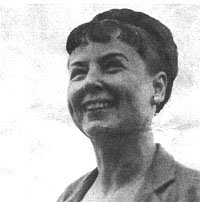
Joan Hoffman, who curates the Holling collection, describes activities there. “The Leslie Area Historical Museum operates under the charter, constitution and by-laws of the Leslie Area Historical Society. The museum workers are custodians of the many historical items, which are cataloged, displayed and properly cared for. The City of Leslie has provided the space we use."

Joan Hoffman


“The Society's function is more fund-raising and lining up public historical programs. They played a big part in the recent 175th anniversary of Leslie. It was Steve Hainstock's vision and effort that initiated both the Society and Museum in 2007. He has a wealth of historical knowledge, and we look to him often for guidance.

“Leslie is a small town,” Joan says. “A major highway once went through town. Since Route 127 was moved to the west and hooked up with the Interstate highway system, many businesses that once were in Leslie are now gone. It seems to me Leslie is looking for its identity like many towns where the major road now bypasses them. Leslie and the area have a lot of history, and that is what a few of us are trying to promote.”

One function of the museum is to be there for visitors, serving individuals and groups. “Groups like Scouts come yearly. We have school groups sometimes and the Chamber of Commerce once a year. One of our people is particularly good at genealogy and maintains a file on families. We work with the town library and have had small displays in their display case, and for awhile we had displays in a vacant store front.”

The Historical Society and Holling collection is housed in the G.A.R. (Grand Army of the Republic) building represented in this postcard. This is on Bellevue, a short distance east of Main St.

“Above the upper window arch,” Joan points out, “are 13 upright rectangular stones that follow that curve. Those represent the thirteen original states. The pole that looks like it divides the window and the 13 stones is a flagpole.


There are only two floors, none at ground level. The museum is in a room in the basement. “See what looks like grates to the left of the steps?” she asks. “Those are our basement museum windows. The corner stone just to the left of the basement windows says 1903.”

If you’re traveling through southern Michigan, you’re invited to take a little time to visit the Holling collection and learn more about one of America’s favorite writers. The Leslie Area Historical Museum is at 107 E. Bellevue Rd., P.O. Box 275, Leslie, MI 49251; 517-589-5220.

Saturday, March 24, 2012

Pictures and Verse from the Past: Follow-up

It is, of course, a major discovery to find a previously unknown daVinci mural hidden behind a painting done years afterwards. But to bibliophiles who cherish Holling’s writing, painting and craftsmanship, it’s equally thrilling to find another copy of a long-lost book after 89 years.


Heather Heath in Livingston, Mont., found Sun and Smoke among donated books, then tracked down the Leslie Area Museum. (Photo by AP)

Heather Heath found Sun and Smoke: a Book of New Mexico Verse among donations to the Community Closet thrift shop in Livingston, Mont. She was the detective who set it aside for further examination, knowing there was something special about the limited edition work. She learned from the online auction site, eBay, that an estimated the value might be $235. This news began making the area papers. Associated Press writer Liz Kearney, chronicling the discovery, notes that Heath wondered at the inscription in the book: “To Florence and Dan, in memory of the 711 Ranch.” Who were Florence and Dan, had Holling ever visited Montana, and where was the 711 Ranch?

Heath then searched the Internet for information about Holling. (She may even have visited this blog.) From biographical information about Holling’s birthplace, she then tracked down Steve Hainstock, a past president and co-founder of the Leslie Area Museum in Michigan. He told her Sun and Smoke was the only book which the museum did not have. Heath stated in the AP story, “It was exciting to get this gentleman on the phone and hear him say ‘Wow!’”

In the spirit of the Community Closet’s policy of sharing with other nonprofits, Executive Director Caron Cooper secured permission to donate the book to the Leslie Area Museum. The folks in Leslie are eagerly awaiting an opportunity to see the verses and art Holling created over three-quarters of a century ago.

A story like this might have remained localized in Livingston, Mont., and Leslie, Mich. Happily, we live in a digital age, when search engines bring the world to our fingertips, communication links span vast distances, and the past is easily accessed by interested audiences everywhere. With so much sad news and tension in the world, it’s satisfying to know a writer like Holling Clancy Holling is still extolling the panorama that is America. And that one more view — of New Mexico in verse and art — has come to light.

Note: Sun and Smoke arrived in Leslie Friday, Mar. 23. Joan Hoffman said, “I went over to the Hainstocks’ house and saw it as the box was opened. The spine of the book is not good, so the book is in quite fragile condition. Steve plans to scan the pages so it won’t have to be handled further.”

Monday, March 12, 2012

Breaking News: Pictures and Verse from the Past


A copy of Sun and Smoke: A Book of New Mexico has appeared! This is momentous news, as only 50 copies of Holling’s handmade book were published in 1923. Four copies are in university libraries and a fifth was sold last year by a rare books dealer.

On Feb. 8, Joan Hoffman learned that “a woman in Montana found a copy of Holling’s rare book in the thrift shop where she works.” A month later, Joan received a call and discovered “they’re donating the book to the Leslie Historical Museum. We were not sure we would get it, and certainly didn’t expect it to be an outright gift.” The book's delivery will be delayed at least until the local press is able to cover the story.

Sun and Smoke was created as a printing arts project when Holling was at the Art Institute of Chicago. The subject matter drew on the preceding months Holling had been in New Mexico. He had traveled extensively by horseback, took in the Taos art scene (and began appreciating color in his own painting), and worked at the ranch where he and Lucille Webster Holling were staying. He wrote the verses, carved wood blocks out of maple to illustrate and decorate the poems, and printed the 36-page book on hand-laid Fabriano paper from Italy. Both the printing and binding — culminating in a 6-1/2 by 10-1/4-inch book — were performed by Holling himself. This was truly an epic example of Holling’s craftsmanship.

Joan comments, “ I know Holling wanted to preserve his impressions of time spent in New Mexico, which he did in Sun and Smoke. I am anxious to see the poems and illustrations he used.”

We all are.

Friday, March 2, 2012

No One Gets Mad Because the Writing Is Too Simple


In the introduction to Dr. Seuss’s The Bippolo Seed and Other Lost Stories, scholar Charles D. Cohen mentions a three-year-old who recited an entire Seuss story! The epiphany for author Theodor Geisel was that children absorb amazing volumes of information through their ears — lesser amounts through their eyes.

Key to Holling’s success was a Fog reading index of 6.9 — meaning that 91 percent of everyday words we use are more difficult. Only 5 percent of Holling’s words are foreign or complex. His choices average just 1.4 syllables per word. And, there are just 12.3 words per sentence.

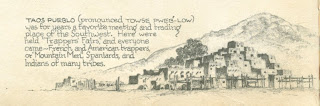
It’s sometimes difficult to slide past polysyllabic environmental terms, or words in other languages. But Holling helps us in those instances, too. Tree in the Trail contains an amazing wealth of sidebar illustrations that explain history or define place names. In describing Coronado’s search for gold [chap. 5; unpaginated], he mentions an Indian town, Zuñi. The pronunciation — zoon-yee — is added parenthetically. Likewise, Santa Fe is spelled phonetically. Describing a Southwest trading and meeting place [chap. 9} he gives us Taos Pueblo and clarifies it as towse pweb-lo. This ease-of-entry is a secret to Holling’s enduring interest among young people and the home-schooled. Dr. Seuss, I think, would agree.

(A note of thanks for to E.J. Hirsch, Jr. for What Your Fifth Grader Needs to Know: Fundamentals of a Good Fifth Grade Education, from which these statistics are cited.)

Thursday, February 2, 2012

Forget Winter and Gaze at Lake Nipigon

A great part of our country is locked in cold and often-gray weather. We spend the winter months dreaming of spring, the return of migrating birds, and memories of swimming in warm waters. But remember: Paddle-to-the-Sea was born on a snowy hillside in Ontario.


If it will help you visualize Paddle’s home, take a moment to look at Lake Nipigon (from the Ontario Parks Dept.) and think of the adventurous route Paddle-to-the-Sea took.

This comes alive again in Deborah Cramer’s commentary that “we are connected to the ocean even if we can’t see it.” She writes (at http://seaaroundyou.com/paddle-to-the-sea/), “In this beloved children’s book, first published in 1941 but still in print, an Indian boy living in the Canadian wilderness near Lake Nipigon carves a canoe and a paddler. When he hears the cry of wild geese returning at the end of winter, he places Paddle-to-the-Sea on a snowy hill behind his home, facing south.”

Ms. Cramer is the author of Great Waters: An Atlantic Passage. Her description of Paddle’s route takes us again through Lake Superior and into Lakes Michigan, Huron, Erie and Ontario, dropping hundreds of feet through rough waters and calm eddies. Holling symbolically illustrated this wealth of clean water in his sidebar comparing the Great Lakes to cups pouring into each other.

She warns, however, that the “watery lifeline” between Paddle-to-the-Sea’s Nipigon River and the ocean are in danger. “If the earth continues to warm, water levels in the Great Lakes will drop. Tiny Paddle-to-the-Sea might make the long journey, but the shallower water may inhibit large cargo ships that ply the waters of the Great Lakes today.”

You can choose whether Holling was first an illustrator, a magnificent storyteller or a naturalist. It's practically impossible to put priorities on a man who so artfully wove the three disciplines together. Paddle-to-the-Sea is as indelibly wedded to the Great Lakes, St. Lawrence Seaway and Atlantic Ocean as Minn was to the Mississippi, Tree in the Trail to the Great Plains, and Seabird to life in the north Atlantic. This is our heritage as much as it is the legacy of these timeless stories.

Deborah Cramer is the author of Smithsonian Ocean: Our Water Our World, the companion to the new Sant Ocean Hall at the National Museum of Natural History. She lives by the edge of the sea, is a visiting scholar at the Earth Systems Initiative at MIT, and speaks frequently to educators and the public about the meaning of the sea in our lives. More information about her and her work can be found at http://deborahcramer.com/