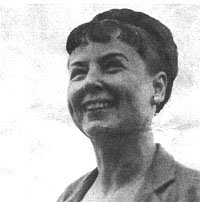

The diligent detective work of curator Joan Hoffman has uncovered full color illustrations done by Lucille Webster Holling when she and her husband, Holling, undertook an assignment in Texas. [They’re reproduced at the bottom this site.] She found and purchased the postcards from a seller on eBay, and they recently arrived.
These postcards were published about 1941, Joan believes. “They are like the Indian dancers [Holling] painted at the new Hilton Hotel in Lubbock, Texas, at the end of 1929. This was a speedy assignment, as Holling and Lucille arrived in Lubbock on Christmas Eve and completed the job by the hotel’s opening on New Year’s Eve.”
After arriving at the new Hilton Hotel in Lubbock, “They decided to do the huge dining room walls in different Indian dances which they had seen in New Mexico. Lucille started the dining room paintings, while Holling began the cartoon sketches for the three walls of the coffee shop. It is not clear if Holling had a part in the sketching and painting of the Indian dances, if Lucille also helped with the cartoons, or if they both just worked wherever to get the job done in a short amount of time. But the postcards [with the exception noted below] are just credited to Lucille.”
Joan also mentions there is a series of paintings of Indian craftsmen, of which she has five. But, she says, “I have no idea how many different ones there are in each series.
The commentary on the back of the Yucca Kachina is interesting because the yucca was considered lucky. The back of that card states, “Indians of northern Arizona and western New Mexico (mainly Hopi and Zuni) believe in sacred Kachinas, beings who live in the spirit World. From December through July these Kachinas leave their homes to visit mankind, bringing such blessings as rain for corn crops. It is a sacred duty, fraught with risk, for pueblo men to impersonate these Kachinas in seasonal ceremonies. The performer feels that he himself becomes the spirit, having its mysterious powers, when he dons the mask. There are hundreds of Kachinas with forms of birds, animals, reptiles and natural forces. Each has its own ceremonials. Half the cultural life of these Indians revolves around spiritual values of Kachinas, their songs and dances. Kachina dolls make pueblo children familiar with each Kachina. The Kachina pictured here wears a Yucca-leaf skirt and is known as “He Who Wears a Yucca Kilt.” This useful plant has long been essential to these Indian peoples. (This one of a series of Southwest Indian dancers designed by L.W. Holling, on Yucca veneer.)”
The Corn Dancer postcard may not have been designed by Lucille Holling. While the text is similar to the others, it does not give her credit.
Joan Hoffman’s work is “ephemera archeology” of the first order – finding and securing 70-year-old postcards and archiving them for posterity. Congratulations!-
Sunday, January 23, 2011

Thursday, December 23, 2010
HCH Information to ABC Organization
It was so nice to see my short letter on Holling Clancy Holling become an article in the American Book Collectors of Chidlrens' Literature spring/fall 2010 newsletter, at http://www.abcocl.org/newsletter.htm.
Billie Levy, the editor, published an earlier article on Holling several years ago, and this helps keep the writer/artist's memory alive. Little by little, more of holling's work is being uncovered in what I can only call "literary archeology."
Billie Levy, the editor, published an earlier article on Holling several years ago, and this helps keep the writer/artist's memory alive. Little by little, more of holling's work is being uncovered in what I can only call "literary archeology."
Thursday, November 18, 2010
Paddle-to-the-Sea Film Is Stunning
We can all be indebted to Eli Ross and his response to my last post that a 28-minute Paddle-to-the-Sea film is available. (See www.nfb.ca/film/paddle_to_the_sea) This is Bill Mason’s film adaptation of the classic tale for the National Film Board of Canada.
It’s a film of pure joy. Please share it with your children…those of all ages.
It’s a film of pure joy. Please share it with your children…those of all ages.
Friday, November 5, 2010
Paddle-to-the-Sea, Timeless
So much effort, time and money are plowed into education and entertainment that it’s refreshing to note a simple work of art like Paddle-to-the-Sea is now approaching its 70th birthday and is still very much in print. In fact, Amazon.com has reduced the price of the hardcover to $13.60 and the paperback $8.60 as of this writing.
And it’s still the same charming, wonderful story. Joan Hoffman writes from the museum in her fall newsletter that a Michigan teacher told her she is currently reading Paddle-to-the-Sea with her fourth graders. She goes on to say, “The beauty of the language is such an important connection to teaching them to be better writers through the use of descriptive adjectives, great verbs and all the wonderful comparisons he has.”
If you would like to receive the newsletter, contact Joan at ronandjoanhoffman@yahoo.com. This issue discusses the work Holling did for Walt Disney, his early canoeing experiences in the area where he grew up, and his later home in southern California.
And it’s still the same charming, wonderful story. Joan Hoffman writes from the museum in her fall newsletter that a Michigan teacher told her she is currently reading Paddle-to-the-Sea with her fourth graders. She goes on to say, “The beauty of the language is such an important connection to teaching them to be better writers through the use of descriptive adjectives, great verbs and all the wonderful comparisons he has.”
If you would like to receive the newsletter, contact Joan at ronandjoanhoffman@yahoo.com. This issue discusses the work Holling did for Walt Disney, his early canoeing experiences in the area where he grew up, and his later home in southern California.
Saturday, August 21, 2010
Holling’s Effect in Far Parts of the World
Joan Hoffman “introduced” me this week to a Holling fan who is a noted illustrator and portrait artist in his own right in New Zealand. I sent a note to Harmen Hielkema asking if he would elaborate on the influence Holling’s book had on his you. Below is the miniature memoir he sent back to me. I hope you enjoy it as much as I have.
On my 7th birthday my grandfather, Henk Oostenrijk from the Netherlands, sent me a book voucher.
My mother and father took me to a bookstore in Auckland City where I chose Seabird, a beautiful, hard cover book for children written and illustrated by Holling Clancy Holling and published by Collins on the subject of Whaling. My mother dedicated the book for me by writing my birth date and my grandfather’s name on the flyleaf.
I no longer have that original copy. It was donated without my knowledge or approval to a local school fundraising book auction when my children were still attending primary school.
It did solve my father’s problem of what to give me for my 8th birthday. My obsession that year with Seabird gave him the cue. I received from him a copy of Paddle to the Sea. The following year it was Tree in the Trail.
Those three books changed my life forever. Long before I fully appreciated the literary contents of those books I was gazing in awe at Holling’s illustrations, many of which I copied. Not only that, I began to build my own canoes--models at first, and then on to the real thing.
Like Holling, I had a curiosity about many things and this lead to an interest in the canoes and the people of the Pacific Ocean. I was compelled to make sailing models of outrigger canoes, whittled out of the dry, woody flowering stems of the flax plant that flourishes in the coastal areas of New Zealand. My friends and I would send them racing across the bay and watch them diminish, longingly wondering where they might eventually end up, as they dwindled from sight; out to sea.
My first real canoe was designed by New Zealand designer, Frank Pelin, and built to his plans by my father and me. That canoe was a 15 foot, plywood, hard chine adaptation of an American Indian birch bark canoe. I named that canoe Seabird, and the canoe taught me about boat handling from a very young age. I used two types of paddle, the double Eskimo kayak style and the other the traditional single paddle. My friends and I cruised the sheltered local waterways north of Auckland where we fished and camped all summer long.
Again much influenced by Holling’s realist style and parallel to his path, I chose a career as a commercial graphic artist and mural painter, which eventually led to sculpture as well. These activities— though not my true passion—helped me to put food on the table for my family.
As I write this, I am now in my 50s and I still cherish and collect copies of Holling’s work. I haunt the children’s section of secondhand bookshops and charity shops always on the lookout for another, yet unseen Holling publication. In this way I have found a 1935 first edition of The Book of Indians, a later Collins republication of the same title, and a 1948 first edition Houghton Mifflin edition of Seabird.
My continuing curiosity about Holling lead me to Walt Giersbach’s blog which seeks to illuminate that which was previously unknown about the life and work of Holling C. Holling and his wife Lucille. Now, thanks to the efforts of people like Joan Hoffman of Michigan and others, details and artifacts from Holling’s life are being collected, displayed, recorded and published so that more may benefit from Holling’s rich legacy, the body of work that he left for our benefit and enjoyment.
Thanks, Holling C. Holling for daring to follow your dream and so influence the lives of people like me so far away here in New Zealand.
[More on Harmen Hielkema can be found on his Outrigger canoe blog, http://harmenhielkema.blogspot.com/. Harmen's Art blog is www.harmen.co.nz, and his Music blog is http://harmensmusicblog.blogspot.com/. He lives in Rawene Hokianga, Northland, New Zealand.]
On my 7th birthday my grandfather, Henk Oostenrijk from the Netherlands, sent me a book voucher.
My mother and father took me to a bookstore in Auckland City where I chose Seabird, a beautiful, hard cover book for children written and illustrated by Holling Clancy Holling and published by Collins on the subject of Whaling. My mother dedicated the book for me by writing my birth date and my grandfather’s name on the flyleaf.
I no longer have that original copy. It was donated without my knowledge or approval to a local school fundraising book auction when my children were still attending primary school.
It did solve my father’s problem of what to give me for my 8th birthday. My obsession that year with Seabird gave him the cue. I received from him a copy of Paddle to the Sea. The following year it was Tree in the Trail.
Those three books changed my life forever. Long before I fully appreciated the literary contents of those books I was gazing in awe at Holling’s illustrations, many of which I copied. Not only that, I began to build my own canoes--models at first, and then on to the real thing.
Like Holling, I had a curiosity about many things and this lead to an interest in the canoes and the people of the Pacific Ocean. I was compelled to make sailing models of outrigger canoes, whittled out of the dry, woody flowering stems of the flax plant that flourishes in the coastal areas of New Zealand. My friends and I would send them racing across the bay and watch them diminish, longingly wondering where they might eventually end up, as they dwindled from sight; out to sea.
My first real canoe was designed by New Zealand designer, Frank Pelin, and built to his plans by my father and me. That canoe was a 15 foot, plywood, hard chine adaptation of an American Indian birch bark canoe. I named that canoe Seabird, and the canoe taught me about boat handling from a very young age. I used two types of paddle, the double Eskimo kayak style and the other the traditional single paddle. My friends and I cruised the sheltered local waterways north of Auckland where we fished and camped all summer long.
Again much influenced by Holling’s realist style and parallel to his path, I chose a career as a commercial graphic artist and mural painter, which eventually led to sculpture as well. These activities— though not my true passion—helped me to put food on the table for my family.
As I write this, I am now in my 50s and I still cherish and collect copies of Holling’s work. I haunt the children’s section of secondhand bookshops and charity shops always on the lookout for another, yet unseen Holling publication. In this way I have found a 1935 first edition of The Book of Indians, a later Collins republication of the same title, and a 1948 first edition Houghton Mifflin edition of Seabird.
My continuing curiosity about Holling lead me to Walt Giersbach’s blog which seeks to illuminate that which was previously unknown about the life and work of Holling C. Holling and his wife Lucille. Now, thanks to the efforts of people like Joan Hoffman of Michigan and others, details and artifacts from Holling’s life are being collected, displayed, recorded and published so that more may benefit from Holling’s rich legacy, the body of work that he left for our benefit and enjoyment.
Thanks, Holling C. Holling for daring to follow your dream and so influence the lives of people like me so far away here in New Zealand.
[More on Harmen Hielkema can be found on his Outrigger canoe blog, http://harmenhielkema.blogspot.com/. Harmen's Art blog is www.harmen.co.nz, and his Music blog is http://harmensmusicblog.blogspot.com/. He lives in Rawene Hokianga, Northland, New Zealand.]
Tuesday, July 6, 2010
Leslie Museum Now Opened!
Good news comes from Joan Hoffman's newsletter that the Holling museum has reopened after the flooding that temporaily put it out of business. She writes:
"Now we are back in business. The museum looks great and we had the best ever June visitor attendance. The Holling display portion of the museum turned out well, I think. Thanks to generous gifts of Holling items along with what we had, the displays have taken on a new look."
Main display parts, unified by labeled miniature canoe paddles, include:
• A two shelf glass case houses Holling items telling the story of Holling's years in the local area. On top of the case is an aquarium with two live hermit crabs. They help us tell the story of Pagoo.
• On the wall behind the glass case hang a framed portrait of Holling and three of his framed original paintings.
• On the left is a divider. This will be a rotating display of Holling's commercial art work. Currently appearing are Junior Home Magazine covers from 1928-29.
• To the right is a tall multi-shelved cabinet displaying Holling's children's books. There is a spot for Paddle, a model pueblo, a picture of the Hollings in the late 1930s looking over several of their World Museum dioramas,an assembled diorama and much more. Atop the cabinet is the long bow Holling made and used.
• Holling's Army jacket also is displayed. The story about that jacket appears elsewhere in the newsletter and earlier in this blog.
"Now we are back in business. The museum looks great and we had the best ever June visitor attendance. The Holling display portion of the museum turned out well, I think. Thanks to generous gifts of Holling items along with what we had, the displays have taken on a new look."
Main display parts, unified by labeled miniature canoe paddles, include:
• A two shelf glass case houses Holling items telling the story of Holling's years in the local area. On top of the case is an aquarium with two live hermit crabs. They help us tell the story of Pagoo.
• On the wall behind the glass case hang a framed portrait of Holling and three of his framed original paintings.
• On the left is a divider. This will be a rotating display of Holling's commercial art work. Currently appearing are Junior Home Magazine covers from 1928-29.
• To the right is a tall multi-shelved cabinet displaying Holling's children's books. There is a spot for Paddle, a model pueblo, a picture of the Hollings in the late 1930s looking over several of their World Museum dioramas,an assembled diorama and much more. Atop the cabinet is the long bow Holling made and used.
• Holling's Army jacket also is displayed. The story about that jacket appears elsewhere in the newsletter and earlier in this blog.
Monday, June 21, 2010
“Keep It Simple” Formula
One of the secrets to Holling’s enduring interest by young people is his simplified vocabulary. Dr. Seuss—Theodor Geisel—also realized this with his severely truncated lexicon in stories like The Cat in the Hat.
Holling’s Paddle-to-the-Sea has a Fog Index of 6.9, meaning 91% of everyday words we use are more difficult to read. His Flesch Reading Index score is 75.2, meaning 90% of other vocabulary is harder. Similarly, only 5% of Holling’s words are “complex. His word choices have just 1.4 syllables per word. And, there are just 12.3 words per sentence.
This doesn’t mean Holling wrote down to youngsters or was patronizing. It does mean a fifth grader can easily pick up a Holling book and understand the story. Home schooling sources regularly cite Holling’s books for their educational value. But, to a nine-year-old, Holling is a captivating guide to new worlds.
(A note of thanks for to E.J. Hirsch, Jr. for What Your Fifth Grader Needs to Know: Fundamentals of a Good Fifth Grade Education, from which these statistics are cited.)
Holling’s Paddle-to-the-Sea has a Fog Index of 6.9, meaning 91% of everyday words we use are more difficult to read. His Flesch Reading Index score is 75.2, meaning 90% of other vocabulary is harder. Similarly, only 5% of Holling’s words are “complex. His word choices have just 1.4 syllables per word. And, there are just 12.3 words per sentence.
This doesn’t mean Holling wrote down to youngsters or was patronizing. It does mean a fifth grader can easily pick up a Holling book and understand the story. Home schooling sources regularly cite Holling’s books for their educational value. But, to a nine-year-old, Holling is a captivating guide to new worlds.
(A note of thanks for to E.J. Hirsch, Jr. for What Your Fifth Grader Needs to Know: Fundamentals of a Good Fifth Grade Education, from which these statistics are cited.)
Subscribe to:
Posts (Atom)